Local Crafts
Eri Silk: Threads of Tradition

What is Eri Silk
Ryndia, the Khasi name for Eri silk, comes from the Ryndia (castor) plant that feeds the silkworms. Known as Peace Silk or Ahimsa Silk, it's cruelty-free—unlike other silks, the yarn is extracted without killing the silkworms. Though not as smooth as mulberry or Muga, Eri has a wool-like texture and is the only silk whose yarn is spun, not reeled.

The Making of Eri Silk
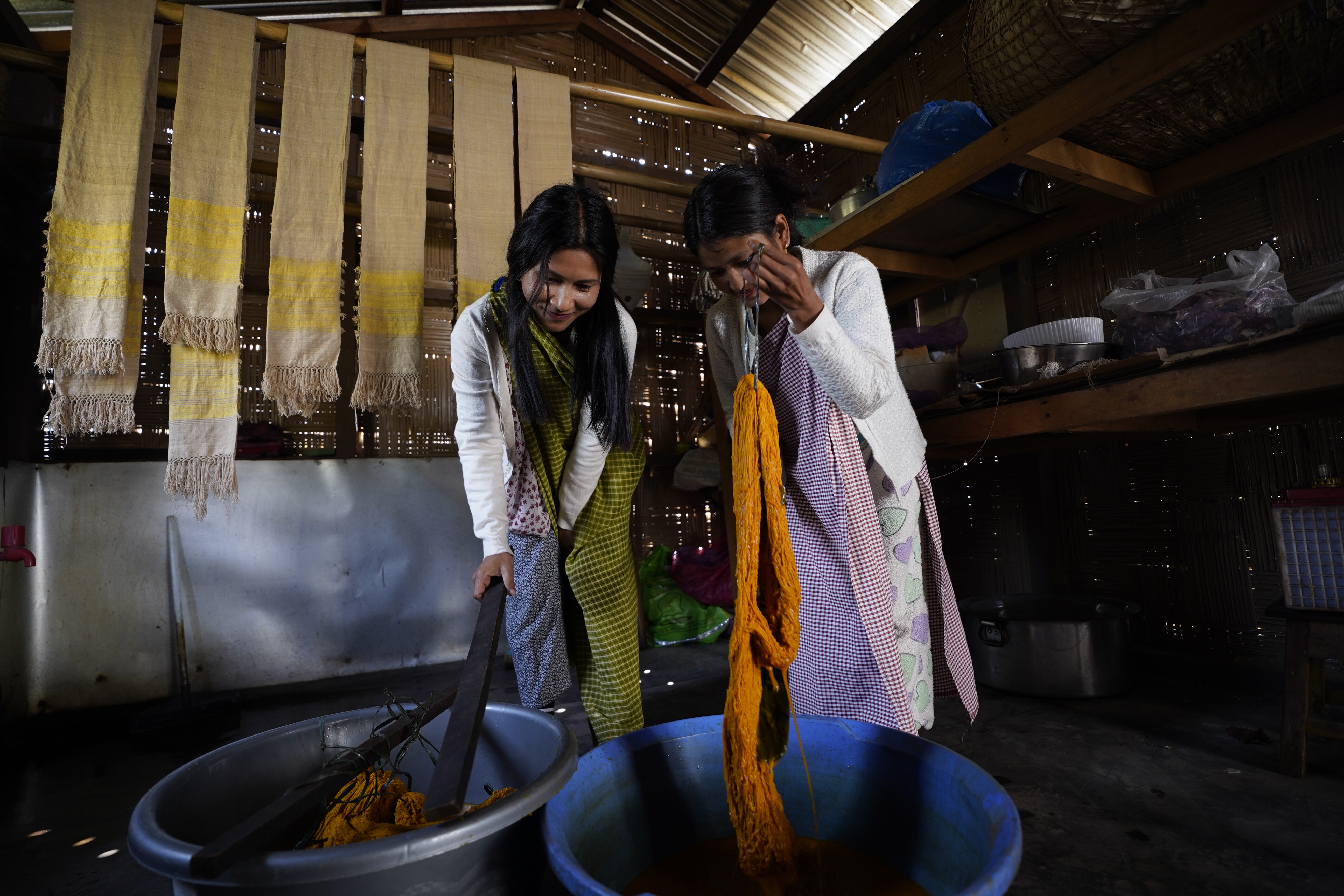
The process of Ryndia production is done in a completely sustainable set-up. The silkworms are not killed during the cocoon extraction process; instead, weavers wait until the pupae come out and the cocoon goes for the boil. Natural dyes are used that are procured from grinding and boiling ingredients like turmeric, onion peel, lac, and iron ore.

Cultural Significance
Ryndia production is a gynocentric workforce where women take up every step of production, from rearing silkworms to procuring wool, weaving, dyeing, and marketing. Moreover, this age-old tradition is carried on by women where knowledge and skills are passed down from mother to daughter. Women identify themselves as a weaving community, strengthening their position in the community and economic landscape.

Sustainable and Ethical Fashion
Sustainably produced, Ryndia is highly valued due to its thermoregulatory property and can last a decade if properly cared for. Ryndia is the preferred sartorial choice among men and women, especially on festive occasions. The design is simple and timeless, defying fast fashion and over-consumption.

Eri in Contemporary Design
A wave of home-grown brands and fashion houses such as Kiniho, Eriweave, Daniel Syiem's Ethnic Fashion House, Ri & Last, and Zong hi I, are redefining Ryndia with fresh, innovative designs that fuse tradition with modern aesthetics. Inspired by the region's folklore, nature, and way of life, these entrepreneurs are transforming the heritage fabric into contemporary fashion statements.

Where to See and Experience it
The Design, Innovation & Resource Centre (DIRC) was set up at the Umden-Diwon cluster, Ri-Bhoi district of Meghalaya, in collaboration with the National Institute of Fashion Technology (NIFT) to make Unden-Diwon the first Eri Silk Village. It acts as a medium for weavers to innovate, record and share information on new techniques and processes. The DIRC is a one-stop centre for weavers, dyers, researchers, and aspiring learners to come together to discover and learn the rich textile traditions of the state.

Where to Buy
The Meghalayan Age Store, New Delhi
https://themeghalayanage.store/Kiniho Store, Laitumkhrah, Shillong
https://kiniho.com/Muezart, Umshing-Mawkynroh, Shillong, Meghalaya
https://www.muezart.com/collections/muezart-patterns
Larnai Black Pottery
The craft that knows challenges yet continues to shine through the dedication of local artisans, holds a special place in the array of Meghalaya's traditional craft. Khiew-Ranei or Black pottery, is known for its unique aesthetic, long-lasting properties, and cultural significance.
Khiew-Ranei, or black pottery, is a traditional craft practice using a blend of black clay and serpentine stone. This unique form of pottery is distinguished not only by its raw materials but also by the intricate techniques used—methods that have been carefully preserved and passed down through generations. The entire process, from shaping to firing, reflects a deep connection to local heritage and craftsmanship.

Located approximately 58 kilometers from Shillong, the journey to Larnai takes around 2 to 2.5 hours by road
Just 20 kilometers away, Jowai serves as the nearest urban hub to Larnai
The nearest town is Ummulong, which is approximately 4 km away, shared sumos and taxis are available from Ummulong taxi stand
Don't Miss
Watch live demonstration of skilled artisans shaping clay entirely by hand—without using a potter's wheel
Insight into the history and culture of the community in Larnai who are involved in the production of Black Pottery
Buy beautiful black pots, pans, kettles, and decorative items and bring home a piece of heritage
Stroll through Larnai to enjoy its peaceful lanes, bamboo homes, and scenic surroundings. It's a great way to experience the everyday rhythm of rural Meghalaya.
When and Where
It is located in Larnai Village, West Jaintia Hills District of Meghalaya
The distance from Shillong Airport is approximately 52 km
The distance from Guwahati Airport is approximately 166 km
The ideal time to visit is between the months of October and March, as there is less chance of a heavy downpour, making it easy to traverse through the village
Visitors can visit during the day, ideally from 10:00 AM to 4:00 PM
Nearby Attractions

Thadlaskein Lake

Jowai

Syntu Ksiar/ Ialong
Aminda Rangsa Art Village
A sustainable cultural oasis of intricate wood and stone sculptures in the wilderness of West Garo Hills.
Handum Marak's wood and stone carvings celebrate the rich motifs and practices of Garo culture. From abstract representations and detailed statues to the celebration of local wildlife, every corner of the village is adorned with intricate designs, created from locally sourced materials. Some of the sculptures are skillfully integrated into a living tree, crafting a harmonious fusion of contemporary art and nature, without disrupting the natural balance. The Amindagre Area People Welfare Association was formed to help keep the town clean and support local artists skilled in wood and stone carving.

The art village is accessible from Tura, West Garo Hills, about 20 km away
Public and private buses operate within 5 km of the village, and local taxis are available from Gambegre or Tura for the final stretch
Although the tourist places in Meghalaya are enduring and calling, it is advisable to arrange for a local tourist buddy or guide who is knowledgeable of the location and the language
Don't Miss
Witness Handum Marak's wondrous installations featured in every corner of the village
Discover the wood and stone figurines scattered in the village, depicting Garo aesthetics and lifestyle
Admire the charming Garo huts made of stone and wood carvings
Witness realistic wood carvings on a living tree
Wander through the village surrounded by rich and verdant green
When and Where
It is located in the Gambegre Block, West Garo Hills, 20 km from Tura, the nearest town, and 2 km from Gambegre
The distance from Shillong Airport is 322 km and 216 km from Guwahati Airport
Aminda Rangsa Art Village is open to visitors year-round, but preferably from October to March, when there is less chance of a heavy downpour
Tourists are permitted into the village from 06:00 AM to 06:00 PM. It is advised not to overstay the closing time
Nearby Attractions

Nokrek Biosphere Reserve

Balpakram

Siju Caves and Rock Formations