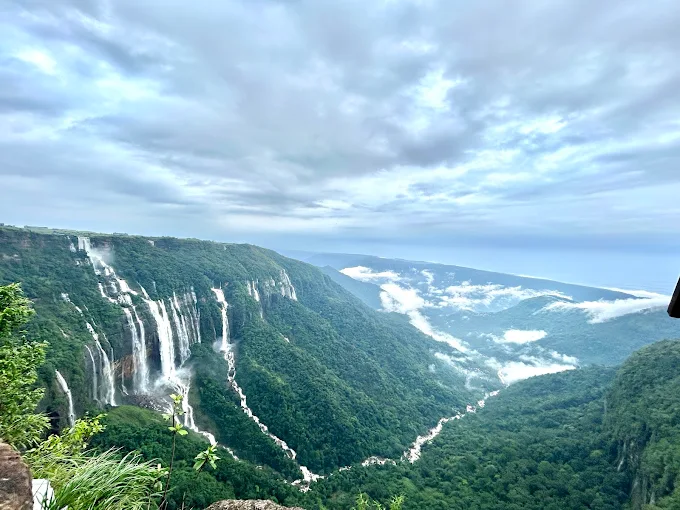
The Seven Sisters Waterfalls
From waterfalls that represent each of the modern states of the Northeast of India to lore that honours the region’s legendary chiefs, this trek has more than enough for you to soak in.
Waterfalls flow from the hills of Meghalaya like rain pours from the clouds that the state takes its name from, freely and frequently. And perhaps one of the most impressive waterfalls here is the Nohsngithiang Falls, better known as the Seven Sisters Waterfalls. On this trek, you’ll not only get a great view of these falls but you’ll also get a chance to bathe in some of the region’s folklore. The Nohsngithiang Falls comprises of seven different streams, each of which is supposed to represent one of the north-eastern states of India. This is where it gets its modern name from. There’s more to this trek than India’s fourth highest waterfalls. Umrohpei means “through the holes” in Khasi, and this is exactly how another waterfall on the trail appears, emerging unexpectedly from a cave in the cliff, thus earning itself this name.

The Seven Sisters Waterfalls
Flora
- The thri or riphin vines that are used to weave a lot of items in the villages can be spotted along this trail. Laitiam village is one of the largest producers of these vines.
Fauna
- Some of the animals you might spot while walking here are antelopes, the Asian black bear, and some species of wildcat.
Fact Sheet
- Region: Khasi Hills.
- Route: Laitiam-Suktia
- Days: 3 night, 4 days
- Total distance: 10 km
- Difficulty: Easy to moderate
- Elevation range: 70-1036 m
- Season: All year long
- Best during: October-May
- Mobile network: Jio and Airtel work best along the trail
- Water availability: Available along the trail
About the Trail
- Day 1: Leave Shillong early, so that you can disembark at the Laitiam roadhead and start the trek to the village in good time. The forest is soothing, and old stepping stones still remain from the path the villagers built before the modern road connection. Be careful, though, as the stones can be a bit slippery. If you take a short detour off the trail, you’ll spot the Umrohpei Waterfall that almost magically appears out of the caves in the cliffs. And don’t forget to keep an eye out for the flagship sight of this trek, the Seven Sisters Waterfalls. The final kilometre throws up a challenge in the form of a steep descent, but you can use the Mawsieniong ladder to ease your way as you approach Laitiam.
- Day 2: Start the day by walking around the Laitiam village. You will find a natural water pool near the campsite. There are five sacred forests around the village, so visit a few of them before setting off for the campsite on the banks of the Wah Lyngngam. Two living root bridges named Usten and Sohpal await you on this part of the trail. Five kilometres into this trail, the road forks and offers a diversion to Suktia. Take this route, and you’ll reach the campsite in 500 metres.
- Day 3: Wake up early to enjoy a swim in the river before you pack up and leave for Shillong. On the way, stop in Suktia to explore the village.
How to Get There
- The Laitiam roadhead is well connected to the main road and hence to Shillong.
- Getting a cab to bring you here will be easy.
- Getting a cab from Suktia should also not be hard
- However, as with villages anywhere, local transport systems are subject to sudden change.
- It might be more prudent to book your car from Shillong itself to drop you and fetch you a few days later.